
Introduction
Walk into a newly finished house and you can usually tell, even with your eyes closed. The air smells faintly of paint and plaster. Every edge is sharp. Every surface is untouched. The floors are perfectly level from wall to wall, like a 3D render that just became solid. It’s impressive. It photographs well. But sometimes, it feels like a stage set waiting for a life that hasn’t arrived yet.
Now imagine opening the same front door and feeling something different underfoot: cool stone with a gentle movement to it, wide slabs with softened edges, small dips that slow you down by half a step. You look down and nothing about the floor feels recent. The color is warm but quiet—creams, beiges, soft grays—with shadows caught in the low spots and light brushing the high points. You don’t know the full story yet, but your first instinct is that this house has history.
That first impression is what Antique Dalle de Bourgogne flagstone does best. It gives a brand-new space the grounded feeling of a place that has already been lived in, without any of the fakery that comes with manufactured “patina.”
.JPG)
Modern living room with French limestone flooring and a stone fireplace. Photo by Neolithic Materials
The First Step: What You Feel Before You Know the Story
Most people encounter Antique Dalle de Bourgogne with their bodies before their brains catch up. The slabs are thicker and larger than the tiles we’re used to. The surface isn’t shiny or aggressively textured; it’s quietly irregular. You can walk barefoot across it and feel small shifts in height, places where someone else’s footsteps, centuries ago, wore a shallow path.
The rhythm of the joints is different too. Edges are gently rounded instead of sharp. Lines between pieces are visible but relaxed, not laser-straight. When sunlight filters in through glass doors, it doesn’t bounce in harsh streaks; it breaks over the subtle highs and lows, so the floor glows rather than glares.
Even without any explanation, people tend to move differently on this kind of surface. They slow down, look around, and register the house as something more permanent than the usual “new build” experience. There’s an immediate sense that the floor isn’t starting its life with you—it’s already in the middle of its story.
Burgundy Beneath Your Feet
The story starts in eastern France, in the Burgundy region better known for wine than for stone. Beneath the vineyards, there’s a limestone ridge that has shaped the area’s architecture for centuries. From the medieval period through the 17th and 18th centuries, local builders turned to that limestone when they needed a floor that could handle reality, not just decoration.
These weren’t grand palace projects. Dalle de Bourgogne was laid in farmhouses, manors, abbeys, cloisters, and agricultural buildings. It paved courtyards where carts rattled through, kitchens where firewood was dragged across the threshold, and passageways that dealt with mud, animals, and hard winters. The stone was chosen because it was available, tough, and strong enough to earn its keep.
The slabs being reclaimed today are the survivors of that life. They’ve already been through revolutions, changing owners, changing uses, and decades of everyday wear. When they’re lifted from their original setting, cleaned, sorted, and shipped to a new project, they bring that timeline with them in a way no newly quarried stone can match.

Historic dining room with French limestone flooring. Photo by Neolithic Materials
Hand-Split, Hand-Worn, Never Repeated
Part of what makes Antique Dalle de Bourgogne so distinctive is how it was made in the first place.
Before diamond saws and industrial cutters, stone was split from the quarry by hand. Workers used basic iron tools to follow the natural bedding planes in the rock. Instead of slicing a block into identical pieces, they persuaded it to break where it wanted to break. The result was a series of thick, weighty slabs whose surfaces followed the internal grain of the stone rather than a mechanical pattern.
Once those slabs were laid, they were flattened and polished the slow way: by being used. Hundreds of thousands of footsteps, scrubbing brushes, chair legs, and iron-rimmed wheels gradually knocked off the sharpness and left behind a surface that’s neither rough nor polished, but something in between.
You can read that process in every piece. One slab might have a slightly deeper dip at one edge where people always walked. Another might show faint tool marks, a soft groove, or a change of color where part of it was more exposed to light. No factory distressing can quite mimic that mix of intention and accident. Each piece has its own personality, and when you lay a room in Antique Dalle, you’re composing with those individual histories rather than repeating a printed pattern.

Antique French limestone pavers arranged in a garden walkway. Photo by Neolithic Materials
How Old Stone Behaves in a New House
Drop this material into a contemporary floor plan and it does interesting things to the architecture around it.
In a large entrance hall, where new builds can sometimes feel like hotel lobbies, Antique Dalle de Bourgogne pulls the mood back down to earth. The scale of the slabs suits generous spaces, but the worn surface keeps the room from feeling too pristine. Guests step in, feel the stone, and instantly understand that this is a house meant to be used, not tiptoed through.
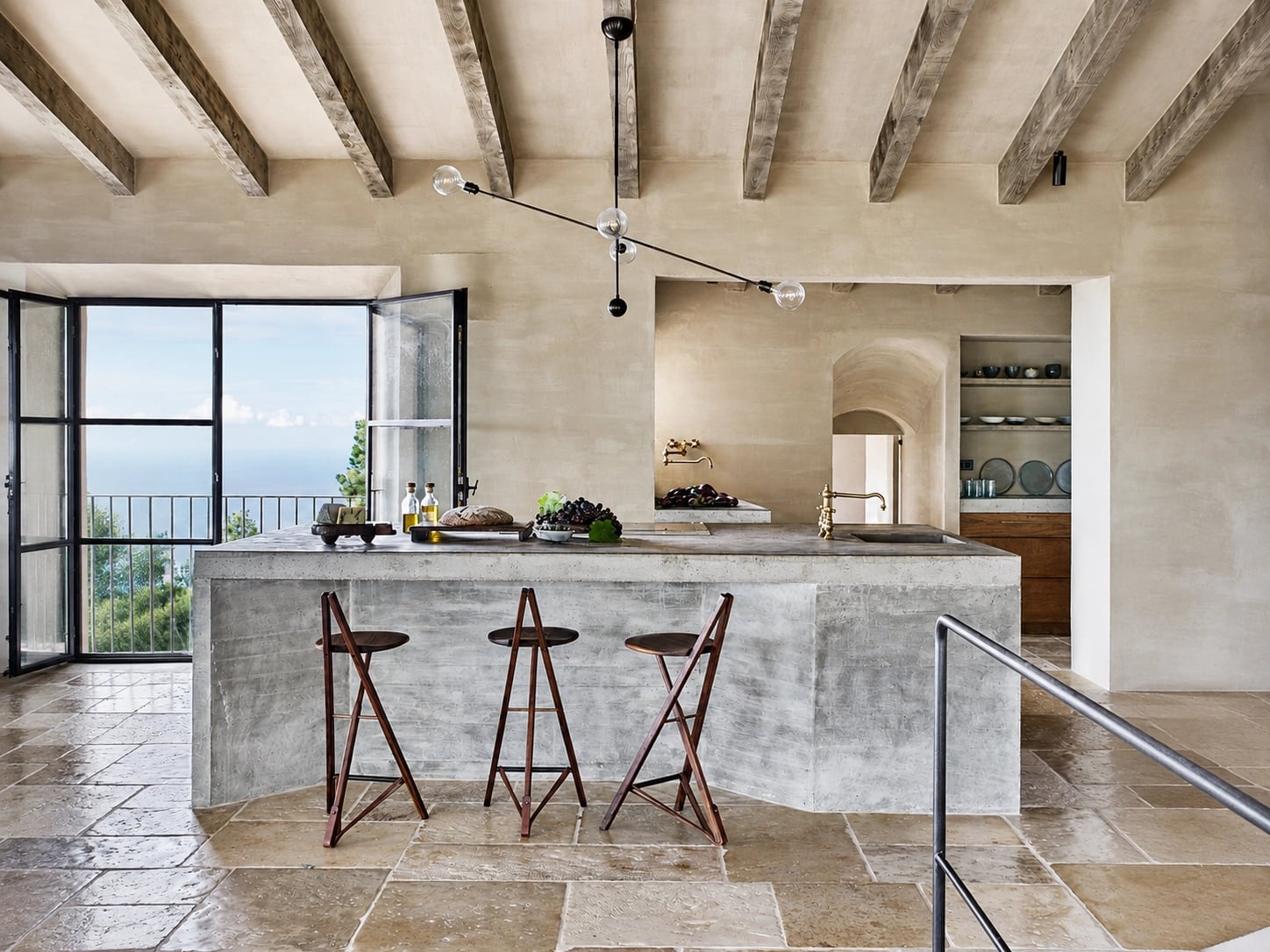
In kitchens and dining areas, where modern life often revolves, the stone becomes a kind of visual and emotional anchor. Stainless-steel appliances, sleek counters, and built-in storage can easily drift toward “showroom” territory. A reclaimed limestone floor cuts that edge. It pairs easily with painted cabinetry, raw woods, brass hardware, and natural stone tops, but it also sits comfortably under more minimal, monolithic kitchens. Spills wipe up, chairs drag across, and the floor absorbs all of it without drama.

Elegant kitchen with natural stone flooring and custom cabinetry. Photo: by Neolithic Materials

Traditional kitchen with warm-toned French limestone floors. Photo: by Neolithic Materials
Light is another part of the equation. In houses with big glass walls and skylights, new polished floors can create glare and visual noise. Antique Dalle’s matte, varied surface breaks up the reflections and absorbs more light than it throws back. Morning sun catches the cooler gray tones. Late afternoon and evening lighting picks up the warmer beige and honey notes. The room feels different at different times of day, but never harsh.
And then there’s the simple day-to-day relief of living with a material that doesn’t demand perfection from you. With this stone, nobody panics about a dropped fork, a scuff from a chair, or a splash of sauce. The floor has already taken centuries of harder use than most modern families will ever throw at it. You’re not waiting for the first mark to ruin the surface; you’re just adding your own, almost invisible layer of use to what’s already there.

Elegant living room with blue glass pendant lights, velvet chairs, white sofas, and a rustic wood-beam ceiling. Photo: by Neolithic Materials
Inside, Outside, One Continuous Surface
One of the hallmarks of current high-end residential design is the desire to erase the boundary between indoors and outdoors. Glass doors slide back, rooms spill onto terraces, pools sit just beyond living spaces. The challenge is making that connection feel natural instead of staged.
Antique Dalle de Bourgogne helps because it’s historically been asked to do exactly that kind of work. It has always existed between interior rooms and the elements: farmyards into kitchens, cloisters into gardens, courtyards into covered walks. It knows how to be both floor and ground.
In a modern house, using the same stone from a kitchen out onto a terrace, or from a gallery down to a pool surround, makes the whole composition feel calmer. There isn’t a jarring switch from interior finish to exterior finish; there’s a shared language underfoot. You can stand in the living room and look out across all of it—the stone, the water, the planting, the furniture—and everything feels like it belongs to the same place.
Technically, the material has already survived freeze-thaw cycles and weather in Burgundy for generations. When it’s chosen and installed correctly for a new climate, it can do the same again. The bonus, stylistically, is that the exterior spaces feel as considered and grounded as the rooms inside, instead of reading as an add-on decked out in whatever outdoor tile was available.

Sunlit sitting room with gray furniture, garden-facing windows, and a fireplace. Photo: by Neolithic Materials
Why Reclaimed, When You Could Have Anything?
There’s no shortage of products that try to copy this look. New limestone can be tumbled, sandblasted, acid-washed, and chipped to suggest age. Some of it is very convincing at a glance, and in many projects, it’s a perfectly valid choice.
But at the level where clients and designers are considering Antique Dalle de Bourgogne, the differences start to matter.
With reclaimed stone, the wear patterns are genuinely irregular. The dips in front of an old doorway, the softened lip of a step, the subtle variation in thickness from one piece to the next—those are the result of time, not a machine. The color isn’t a uniform factory treatment; it’s layers of light, air, heat, work, and cleaning slowly changing the surface over centuries.
There’s also the question of supply. New stone is essentially infinite as long as the quarry operates. Antique Dalle exists in whatever amount history has left behind. There are only so many 17th- and 18th-century floors in Burgundy. Only some of them will ever be lifted. Only part of that will be in good enough condition to reuse. That built-in limit isn’t about snobbery; it simply means you’re working with a material that can’t be scaled up on demand.
On top of that, reusing existing stone rather than extracting and processing new blocks fits quietly into a more considered approach to building. It isn’t a marketing slogan, but for clients who think carefully about what they bring into their homes, it’s another small reason to choose reclaimed over newly made “old look” products.

Traditional courtyard with potted plants and wooden chairs. Photo: by Neolithic Materials
A Floor You Can Build a Life Around
Almost every finish we choose for a house is, in some way, tied to the decade it was installed. Certain engineered wood tones, particular tile sizes, specific stains and sheens—years later, you can often date them at a glance. When tastes change, changing those surfaces can mean ripping out big areas of the house, with all the cost and disruption that implies.
Antique Dalle de Bourgogne sidesteps that whole cycle. It doesn’t belong to any current trend because it predates all of them. Its character comes from thickness, scale, and age rather than from a fashionable pattern or color. You can put it under traditional furniture, contemporary pieces, or a mix of both, and it still makes sense. You can redo the kitchen, repaint, move walls, update everything else—and the floor will happily stay.
That, ultimately, is why this particular stone keeps showing up in homes where people could have chosen anything. It’s not about showy veining or statement patterns. It’s about living with a material that has already proved itself over hundreds of years, and letting that quiet confidence sit under everything else you do.
You’re not just picking a finish for now. You’re deciding what the house will stand on for decades, maybe centuries, after the paint colors and furniture have changed. Antique Dalle de Bourgogne is one of the few options that already knows how to carry that kind of weight.

Airy dining room with a rustic pine table and terracotta floor lit by an iron candle chandelier and tall garden-facing windows. Photo: by Neolithic Materials